Posts

WORLD TRADE: CARDIAC ARREST OR DIZZY SPELL

Image
Haugh et al 2016, Cardiac Arrest or Dizzy Spell: OECD policy paper 18 The concensus view on the trade collapse 2008/9 appears to be changing. In 2009 value chains and protectionism were seen as the magnifiers, multipliers if not culprits of the world trade collapse. A recent OECD study by David Haugh, Alexandre Kopoin, Elena Rusticelli, David Turner and Richard Dutu shows what was claimed and analyzed in On the brink of deglobalization: neither value chains nor protectionsim acted as triggers in 2008/9 and value chains may have been an important factor behind the resilience of world trade (that is the recovery in 2010)
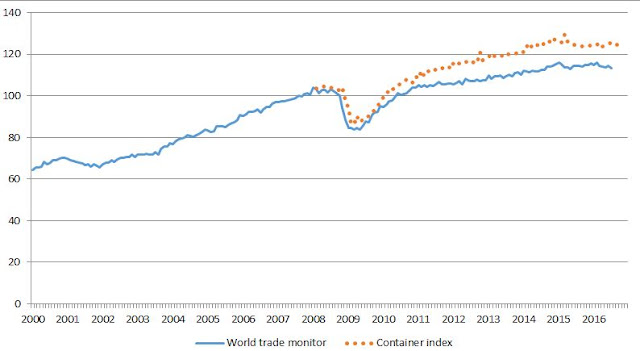
World trade: slow-down or new collapse

Image
Clearly world trade is experiencing difficult  times. the graph above reports two leading indicators. The World trade monitor of CPB Netherlands bureau for economic policy advice ( www.cpb.nl ) and the container throughput index of the Institute of Shipping Economics and Logistics . Bot indicators have been corrected for seasonal influences and provide the most recent indication of the development of world trade. Although the level of the indicators is different the movements are into the same direction and suggest that there is more to the decline in world trade than the price decrease of oil. Container throughput is real and the world trade monitor is reported at constant prices.

Protectionism and the fall in world trade | VOX, CEPR’s Policy Portal

Protectionism and the fall in world trade | VOX, CEPR’s Policy Portal

Philippe Saucier in Études internationales

Le commerce international est-il au bord du gouffre ? Le processus de « globalisation » de l’économie mondiale, l’ouverture aussi bien aux échanges qu’aux investissements directs, présentés longtemps comme irréversibles, ont-ils trouvé leurs limites depuis le déclenchement d’une crise financière en 2008 ? Pour tenter de répondre à cette question, l’auteur avance avec une infinie prudence. Il revendique tout d’abord la primauté des faits, des observations statistiques, sur les conjectures théoriques qui lui semblent trop marquées par des schémas de pensée qui ne prennent pas bien la mesure de bouleversements majeurs et soudains, tels que des crises financières d’ampleur mondiale. Il en voit pour preuve les retards dans la prise en compte du retournement brutal de tendance de l’automne 2008 et, finalement, la sous-évaluation systématique et massive des prévisions d’évolution du commerce mondial. Les experts de l’Organisation mondiale du commerce sont visés. À cet égard, Bergeijk esti...

ECONOMIC DEGLOBALIZATION – FROM HYPOTHESIS TO REALITY by Cătălin Postelnicu, Vasile Dinu, Dan-Cristian Dabija

The Dutch economist van Bergeijk starts [27] from the observation that, during the last years marked by the recent economic-crisis, international trade has undergone a real collapse, comparable to the one recorded during the Great Depression of the 1930s of the last century. To a certain extent, the researcher overemphasises the international trade aspects during the two periods, as well as the completely different causes that determined its breakdown. Still, van Bergeijk broadly demonstrates that the globalization process mainly caused by the international trade fl ows can be summarized in two major causes: social and economic risks and uncertainties caused by the crisis. The author warns of the danger of protectionism revival that seems to be “waiting by the corner”. Therefore, van Bergeijk interprets the decline of international trade to be a clear indication of the deglobalization process of the global economy Postelnicu, Cătălin, Vasile Dinu, and Dan-Cristian Dabija. "Econom...

Sass and Szalavetz on global value chains

On the other hand, certain studies underline the stabilizing impact of GVCs in terms of sustaining trade levels or at least moderating the fall in trade flows. Thus, seemingly unrelated to our topic, Alfaro and Chen (2010) analysed the reaction and role of foreign direct investment (FDI) during the global financial crisis. They examined firm-level data from more than 100 countries for 2007 and 2009. Their results can be related to the GVC approach, because they distinguished and examined three channels through which FDI impacts upon the performance of companies: production linkages, financial linkages and multinational networks. From our point of view, the most important results are that multinationals engaged in activities with vertical production linkages weathered the crisis better than their local counterparts. On the other hand, horizontal FDI was affected more negatively. Moreover, companies operating as part of a multinational network on average performed better; here again, ho...

World trade down

Image
Shortterm contractions of world trade have occured regularly since the 2008/9 trade collapse but this time things mayy be different according to CPB Netherlands Bureau for Economic Analysis: "Because of the volatility of monthly trade figures, momentum is the preferred measure of trade growth.Trade momentum was -1.3% in May (non-annualised), down from -1.2% in April and the lowest reading  May 2009. "