Posts

A natural experiment

Indeed, the current debate on value chains is inconclusive or needs at least more nuance Altomonte et al. (2012) note for France that along a global supply chain shocks as well as recoveries can be magnified due to ‘inventory’ effects (the so-called bullwhip effect) , Wagner and Gelübke (2014) conclude for Germany that the  hypothesis that foreign multinationals are more volatile following a negative shock is not supported by their empirical research, while Behrens et al. (2013) conclude that value chains played a minor role in Belgium (van den Berg and Jaarsma, this special section take an intermediate position for The Netherlands).. It is, however, not the inconclusiveness of the debate that is interesting: it is the heterogeneity of country experiences in Europe that suggests ample scope for finding out more about (regional) resilience. This is the answer to the question ‘Why do the global economic shocks affect regions and their recovery differently?’ that we seek to address. ...

From Deep Globalisation to the Risk of Deglobalisation: the Rise of Local-Contentism by Marcos Troyjo

As the world transitions from ‘Deep Globalisation to Deglobalisation’, economic policies based on a ‘Doctrine of Local Content’ take center stage. As a consequence, the global economy underperforms. Below, Marcos Troyjo argues that Reglobalisation can only resurface if countries move away from ‘Local-Contentism’ and closer to a productive interdependence turning out ‘Made in the World’ goods. Read the full article in The World Financial Review   here

Has globalization had its day (fund strategy)

 “The new policy environment is favourable to bilateralism and protectionism and motivated by political gains, rather than concrete economic effects that will reduce income and employment,” says Peter van Bergeijk, a professor of Economics at Erasmus University, in Rotterdam, who in 2010 published a book presciently titled On the Brink of Deglobalisation. “With the US leaving the coalition for multilateral trade and investment, relationships will reallocate to other countries,” Van Bergeijk says. “US isolationism is an important chance for China.” “Firms should be transparent about the benefits they derive from international activities,” Van Bergeijk adds. “Facts will be important in this debate.” Read rhe full article

WORLD TRADE: CARDIAC ARREST OR DIZZY SPELL

Image
Haugh et al 2016, Cardiac Arrest or Dizzy Spell: OECD policy paper 18 The concensus view on the trade collapse 2008/9 appears to be changing. In 2009 value chains and protectionism were seen as the magnifiers, multipliers if not culprits of the world trade collapse. A recent OECD study by David Haugh, Alexandre Kopoin, Elena Rusticelli, David Turner and Richard Dutu shows what was claimed and analyzed in On the brink of deglobalization: neither value chains nor protectionsim acted as triggers in 2008/9 and value chains may have been an important factor behind the resilience of world trade (that is the recovery in 2010)

World trade: slow-down or new collapse

Image
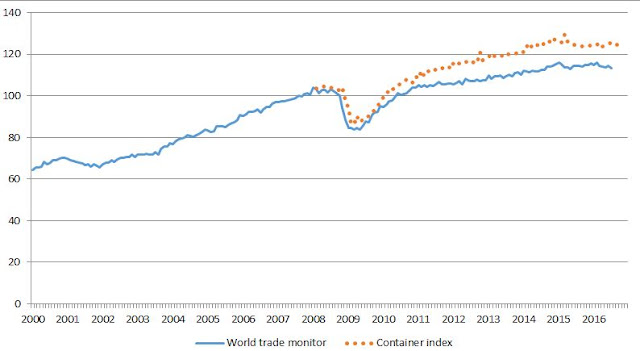
Clearly world trade is experiencing difficult  times. the graph above reports two leading indicators. The World trade monitor of CPB Netherlands bureau for economic policy advice ( www.cpb.nl ) and the container throughput index of the Institute of Shipping Economics and Logistics . Bot indicators have been corrected for seasonal influences and provide the most recent indication of the development of world trade. Although the level of the indicators is different the movements are into the same direction and suggest that there is more to the decline in world trade than the price decrease of oil. Container throughput is real and the world trade monitor is reported at constant prices.

Protectionism and the fall in world trade | VOX, CEPR’s Policy Portal

Protectionism and the fall in world trade | VOX, CEPR’s Policy Portal

Philippe Saucier in Études internationales

Le commerce international est-il au bord du gouffre ? Le processus de « globalisation » de l’économie mondiale, l’ouverture aussi bien aux échanges qu’aux investissements directs, présentés longtemps comme irréversibles, ont-ils trouvé leurs limites depuis le déclenchement d’une crise financière en 2008 ? Pour tenter de répondre à cette question, l’auteur avance avec une infinie prudence. Il revendique tout d’abord la primauté des faits, des observations statistiques, sur les conjectures théoriques qui lui semblent trop marquées par des schémas de pensée qui ne prennent pas bien la mesure de bouleversements majeurs et soudains, tels que des crises financières d’ampleur mondiale. Il en voit pour preuve les retards dans la prise en compte du retournement brutal de tendance de l’automne 2008 et, finalement, la sous-évaluation systématique et massive des prévisions d’évolution du commerce mondial. Les experts de l’Organisation mondiale du commerce sont visés. À cet égard, Bergeijk esti...